
Wiki mirrorView source
Introduction
A DHCP relay agent allows the DHCP clients to obtain IP addresses from a DHCP server that is not configured on the same LAN.
This article provides a configuration example with details on how to set-up a DHCP relay over a L2TPv3 VPN.
Prerequisites
You will need:
- Two RUT or RUTX devices (one as Server and other as Client)
- A PC acting as a Host for testing
- Both routers must have a Public Static or Public Dynamic IP addresses
Configuration Scheme
RUT1 LAN interface configuration
Login to the router's WebUI and navigate to Network → LAN → LAN interfaces → lan. Click the 'Edit' button on the right side of the interface to set the LAN network address.
General Settings
Aplly the following changes:
- IPv4 Address: 192.168.10.1
RUT1 DHCP pool configuration
Login to the router's WebUI and navigate to Network → DHCP → Server Settings → IPv4 → DHCPv4 servers → lan → Edit:
General Setup
Make the Following changes:
- Start IP:192.168.10.150
- End IP:192.168.10.170
RUT1 L2TPv3 Server Configuration
Go to router’s WebUI, under Service → VPN → L2TPv3 and create new L2TPv3 instance.
L2TPv3 instance configuration
Apply the following configuration:
- Enable: on
- Local address: 84.15.XXX.XXX
- Tunnel ID: 100
- Session ID: 100
- Cookie: 12ABCDEF
Peer settings
Apply the following configuration:
- Peer address: 213.130.XXX.XXX
- Peer Tunnel ID: 10
- Peer Session ID: 10
- Peer Cookie: 12ABCDEF
Instance settings
Apply the following configuration:
- Bridge to: lan
- MTU: 1500
- Encapsulation: IP
- Layer 2 specific header type: Linux Default
Note: Specify on "Local address" your mobile WAN public IP. Local value for Tunnel ID, session ID and Cookie must match with the peer values being used at the other end.
RUT2 DHCP Client Settings (Relay)
Login to the router's WebUI and navigate to Network → DHCP → Server Settings → IPv4 → DHCPv4 servers → lan → Edit:
General Setup
Make the Following changes:
- DHCPv4 mode: Relay
- DHCP server: 84.15.XXX.XXX
Note: The IPv4 address of the LAN interface is different from the server's LAN interface address, this is necessary to avoid conflicts.
RUT2 Allow-DHCP-Renew firewall rule changes
Open the router’s WebUI, go to Network → Firewall → Traffic rules → Allow-DHCP-Renew -> Edit and include destination port 67 inside the rule configuration.
RUT2 L2TPv3 Client configraution
Go to router’s WebUI, under Service → VPN → L2TP → L2TPv3 and create new L2TPV3 instance.
L2TPv3 instance configuration
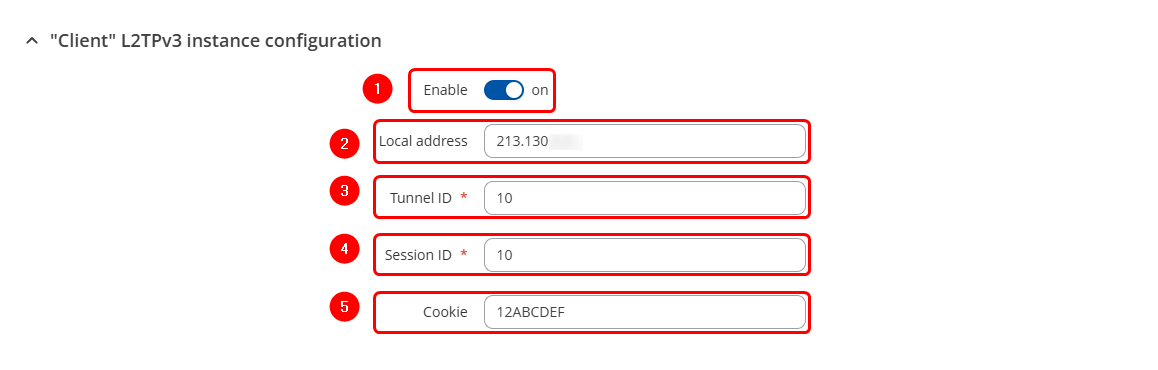
Apply the following configuration:
- Local address: 213.130.XXX.XXX
- Tunnel ID: 10
- Session ID: 10
- Cookie: 12ABCDEF
 Peer settings
Apply the following configuration:
- Peer address: 84.15.XXX.XXX
- Peer Tunnel ID: 100
- Peer Session ID:100
- Peer Cookie: 12ABCDEF
Instance settings
Apply the following configuration:
- Bridge to: LAN
- MTU: 1500
- Encapsulation: IP
- Layer 2 specific header type: Linux Default
Note: Specify on "Local address" your mobile WAN public IP. Local value for Tunnel ID, session ID and Cookie must match with the peer values being used at the other end.
Testing DHCP over L2TPv3
To test the realy settings go to DHCP server to check that devices are able to recieve IP addresses in the range 192.168.10.150 - 192.168.10.170 either via LAN port or Wi-Fi. Access the CLI and run cat /tmp/dhcp.leases to list all DHCP clients.
Asking for the Address Resolution Protocol (ARP) table is also an other method to find hosts on the LAN network.